

Discovering Ice on Your AC: A Startling Summer Problem
Your air conditioner is running nonstop, but the house still feels uncomfortably warm. When you go to check the indoor unit or the outdoor refrigerant lines, you find something completely unexpected: a thick layer of solid ice. At IHACI, we know that getting common homeowner questions answered quickly is crucial in moments like this, especially when you are trying to decide whether to simply change the air filter or call in a professional for a complex repair.
Finding ice on your cooling system is a startling and frustrating experience, particularly during the peak summer cooling season when you rely on your equipment the most. When outdoor temperatures soar, your air conditioner runs for longer cycles to meet the demand of your thermostat. Under normal conditions, this continuous operation keeps your home comfortable. However, if there is an underlying imbalance in the system, those long run cycles exacerbate minor issues, turning a small airflow restriction into a solid block of ice that completely halts the cooling process.
The immediate challenge you face as a homeowner is determining the root cause of the freeze. Is this a simple maintenance oversight that you can resolve in five minutes, or does it indicate a severe mechanical failure that requires advanced technical intervention? Understanding the basics of HVAC education and training helps demystify the problem. By learning how your system operates and knowing exactly what steps to take when ice appears, you protect your equipment from permanent compressor damage while ensuring your home returns to a comfortable temperature as safely and efficiently as possible.
The Science of the Freeze: Why Coil Temperatures Plummet
To understand why your air conditioner turns into a block of ice, you have to look at the basic physics of the refrigeration cycle. Your AC does not actually "create" cold air; instead, it removes heat from the indoor air and transfers it outside. The component responsible for absorbing this heat is the indoor evaporator coil. Warm indoor air blows across this chilled coil, and the liquid refrigerant inside absorbs the heat, turning into a gas before traveling to the outdoor unit.
The problem of condensation: Just like a cold glass of water sweats on a humid afternoon, your evaporator coil pulls moisture out of the indoor air. Normally, this condensation drips down into a drain pan and flows safely out of your home. However, the system relies on a delicate balance of warm airflow and proper refrigerant pressure to keep the coil above the freezing point.
The cause of the freeze: If that balance is disrupted, the heat transfer process fails. The most frequent scientific cause of this failure is coil temperatures dropping below 32 degrees Fahrenheit due to low pressure or restricted airflow. When the coil gets this cold, the natural condensation building up on the metal fins freezes instantly. As the ice layer grows, it acts as an insulator, further blocking warm air from reaching the refrigerant. This creates a compounding effect, causing the temperature to drop even faster until the entire coil and the attached refrigerant lines are encased in ice.
The solution: Restoring the system requires stopping the cooling cycle, allowing the ice to melt completely, and correcting the underlying airflow or pressure imbalance before restarting the equipment.
• Normal Operation — Airflow Status: Unrestricted and steady — Coil Temperature: Approx. 40°F to 45°F — Resulting Moisture State: Liquid condensation (drains away)
• Restricted Airflow — Airflow Status: Blocked or severely reduced — Coil Temperature: Below 32°F — Resulting Moisture State: Solid ice accumulation
• Low Refrigerant — Airflow Status: Normal, but pressure is low — Coil Temperature: Below 32°F — Resulting Moisture State: Solid ice accumulation
Immediate Safe Actions: What to Do When Your AC Freezes
If you discover ice on your air conditioner during the peak summer cooling season, your first priority is protecting the compressor from catastrophic damage. Our network of trained professionals routinely sees how running a frozen AC forces the compressor to work against extreme pressure imbalances, which can destroy the unit. Take these immediate, safe actions to stabilize the situation before attempting any further troubleshooting.
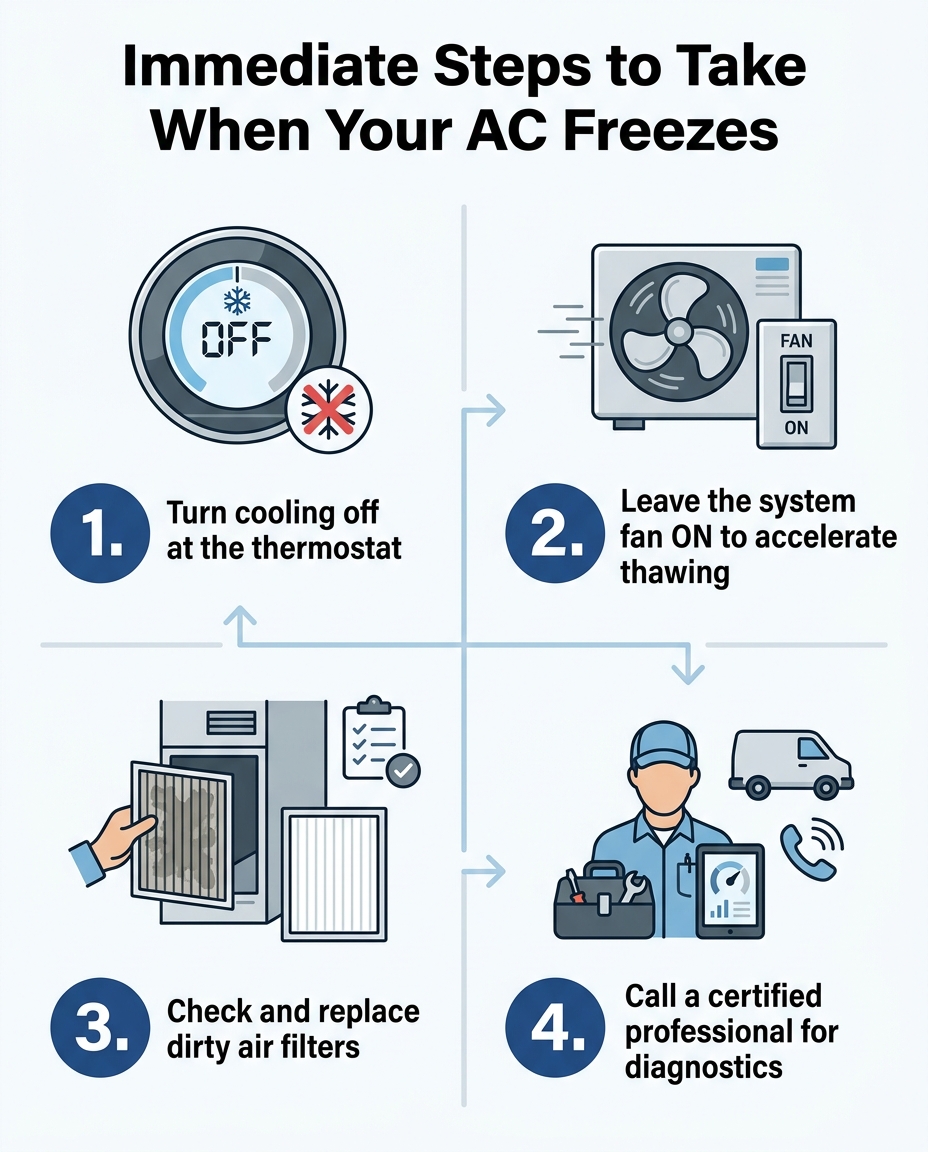
1. Turn the cooling function OFF at the thermostat: Switch your thermostat from "COOL" to "OFF" immediately. This stops the outdoor compressor from running and halts the flow of cold refrigerant to the indoor coil, preventing any additional ice from forming.
2. Switch the system fan to the ON position: Change the fan setting on your thermostat from "AUTO" to "ON." This forces the indoor blower motor to run continuously, circulating warm indoor air over the frozen evaporator coil. This constant flow of warm air is the safest and fastest way to accelerate the thawing process. Never use a hairdryer, heat gun, or sharp tools to chip away the ice, as you can easily puncture the delicate refrigerant coils.
3. Check the air filter for severe clogs: While the system is thawing, locate and inspect your indoor air filter. A filter completely choked with dust, pet dander, and debris is the most common homeowner-resolvable cause of restricted airflow. If the filter is dirty, replace it with a clean one immediately.
4. Call a certified technician if the filter is clean: If you check the filter and find it in good condition, your diagnostic role is complete. A clean filter indicates that the freezing is caused by a mechanical failure, a malfunctioning blower, or a refrigerant leak. Contact a licensed professional to diagnose the system once the ice has fully melted.

Airflow Restrictions vs. Mechanical Failures: Knowing the Difference
Once the immediate danger to the equipment is mitigated, the next step is understanding why the freeze occurred. In our experience working with HVAC systems across the local area, the issues generally fall into two distinct categories: airflow restrictions that you can often manage yourself, and mechanical failures that require professional intervention. The dividing line between the two always comes back to the physics of coil temperatures dropping below 32 degrees Fahrenheit due to low pressure or restricted airflow.
Homeowner-resolvable airflow issues: Your air conditioner needs a specific volume of warm indoor air passing over the coil to function properly. When a severely dirty air filter blocks the return air, the coil absorbs less heat. Without that heat, the temperature of the coil plummets. The same principle applies if too many supply registers are closed or blocked by furniture. Closing vents in unused rooms increases the static pressure inside the ductwork, reducing the total volume of air moving across the system. Opening all vents and replacing the filter restores normal airflow and often solves the freezing issue entirely.
Professional-level mechanical failures: If your filter is pristine and your vents are open, the lack of heat transfer is happening for a mechanical reason. A broken blower motor or a failing capacitor will stop indoor air circulation completely, leading to an immediate freeze. Alternatively, a failing contactor might cause the outdoor compressor to continue running even after the thermostat tells it to stop. The most notorious mechanical issue is a refrigerant leak. When the system loses refrigerant, the pressure inside the evaporator coil drops significantly. According to the laws of thermodynamics, a drop in pressure results in a corresponding drop in temperature, freezing the coil even if the airflow is perfect.
• Dirty air filters: Restricts return air; easily fixed by the homeowner.
• Blocked vents: Increases static pressure; easily fixed by moving furniture or opening registers.
• Failing blower motor: Stops indoor circulation; requires professional electrical diagnostics and replacement.
• Refrigerant leak: Causes pressure drops; requires professional leak detection, repair, and chemical handling.
How Professionals Use HVAC Diagnostic Tools to Find the Fault
When an air conditioner freezes due to mechanical or refrigerant issues, guesswork is not an option. Once the system has completely thawed—a process that we typically see take anywhere from a few hours to a full day—a licensed technician must step in to perform a comprehensive system evaluation. This is where specialized equipment becomes necessary. Understanding the essential diagnostic tools for HVAC troubleshooting helps you see why professional intervention is vital for a lasting repair.
Accurate diagnosis prevents the costly "parts cannon" approach, where a technician simply guesses at the problem and replaces parts unnecessarily. Instead, trained professionals rely on hard data to pinpoint the exact point of failure.
Measuring Refrigerant Pressures Safely
To determine if the freeze was caused by a low refrigerant charge or a failing metering device, technicians connect digital or analog manifold gauges to the outdoor unit. These gauges provide real-time data on the high-side and low-side pressures of the refrigeration cycle. By reading these pressures alongside the ambient outdoor temperature and the indoor heat load, a technician can calculate the exact superheat and subcooling measurements of the system. Interpreting this data requires extensive training, as a low pressure reading does not always mean the system is low on refrigerant; it could also indicate a restriction in the refrigerant line or a malfunctioning expansion valve.
Electrical Diagnostics and Blower Motors
If the refrigerant pressures are normal, the technician will turn their attention to the electrical components that drive system airflow. Using a digital multimeter, they verify the voltage and amperage reaching the indoor blower motor. A multimeter allows the technician to test the strength of the motor's run capacitor, check for electrical shorts, and measure the exact electrical draw of the motor while it operates. Attempting electrical troubleshooting without proper tools and training poses severe safety risks, including the potential for lethal shocks or starting an electrical fire. Proper diagnostic tools ensure the technician can identify a failing motor before it burns out completely.
The Importance of EPA Certification and Proper Training for Refrigerant Handling
When a frozen air conditioner points to a refrigerant leak, the repair process enters highly regulated territory. Refrigerants are complex chemicals that pose significant environmental and safety hazards if mishandled. This is why the Environmental Protection Agency (EPA) mandates that only certified professionals can handle, recover, and recharge HVAC refrigerants under Section 608 of the Clean Air Act.
Attempting a "DIY recharge" with off-the-shelf kits is not only illegal in many jurisdictions but also highly dangerous. Improper handling of pressurized refrigerants can cause severe frostbite, eye damage, and respiratory issues. Furthermore, venting these chemicals into the atmosphere contributes heavily to ozone depletion and global warming. From a mechanical standpoint, adding the wrong type of refrigerant or overcharging the system can instantly destroy the compressor, turning a manageable repair into a total system replacement.
This strict regulatory environment highlights the necessity of formal education for anyone pursuing careers in HVAC. Through our comprehensive training programs at IHACI, we prepare technicians to handle these chemicals safely, legally, and accurately. During their education, technicians learn how to use recovery machines to safely extract old refrigerant, how to braze copper lines to permanently seal leaks, and how to use vacuum pumps to remove moisture from the system before recharging it. The complexity of the refrigeration cycle demands a deep understanding of thermodynamics, chemistry, and environmental law, proving that refrigerant management is never a job for an untrained hand.
Setting the Standard: What to Expect from a Highly Trained Technician
When you invite a professional into your home to diagnose a frozen air conditioner, you should expect a high standard of precision and transparency. From our perspective as an industry educator, the difference between a parts-changer and a true diagnostician comes down to their commitment to foundational training. Organizations like ours, dedicated to industry excellence, emphasize that a qualified technician focuses on finding the root cause of the failure, rather than just treating the symptom of the ice.
A highly trained technician will arrive with the proper diagnostic tools and will take the time to let the system thaw completely before attaching gauges. They will clearly explain their findings to you, translating complex pressure readings and electrical measurements into plain, understandable language. More importantly, they adhere strictly to safety protocols, ensuring that no refrigerant is vented and all electrical panels are properly secured.
The HVAC industry is constantly evolving, with new diagnostic technologies, changing efficiency standards, and updated environmental regulations emerging every year. Technicians who participate in ongoing education, such as HVAC training seminars, stay ahead of these changes. They know how to service the latest high-efficiency variable-speed equipment just as well as older single-stage units. By choosing a contractor who prioritizes continuous, rigorous training for their staff, you protect your investment, ensuring that your system is repaired correctly the very first time, keeping you safe and comfortable throughout the peak summer cooling season.
Frequently Asked Questions About AC Freezing and Diagnostics
What should I do if my AC freezes up?
The very first thing you must do is turn the cooling function off at your thermostat to protect the compressor from damage. Next, switch the system fan setting to "ON" to continuously circulate warm indoor air over the frozen coil, which accelerates the thawing process. Once the system is off, check your air filter and replace it if it is heavily soiled. If the filter is clean, leave the system off and contact a licensed HVAC professional.
Why is there ice on my AC refrigerant lines?
Ice forms on refrigerant lines when the temperature of the indoor evaporator coil drops below freezing, causing natural condensation to freeze onto the metal. This temperature drop happens when the refrigerant cannot absorb enough heat from your home's air. The two most common culprits are severely restricted airflow (like a blocked filter or dead blower motor) or a drop in system pressure caused by a refrigerant leak.
Can a dirty filter cause an AC to freeze?
Yes, a dirty air filter is the most common homeowner-resolvable cause of a frozen air conditioner. When a filter becomes choked with dust and debris, it acts as a wall, preventing warm indoor air from reaching the cold evaporator coil. Without that warm air to absorb, the coil's temperature drops rapidly, causing condensation to freeze solid across the fins and eventually spread to the outdoor lines.
Should I turn off my AC if it's freezing up?
Absolutely. You must turn the cooling function off immediately when you discover ice on any part of your air conditioning system. Allowing a frozen system to continue running places immense strain on the outdoor compressor, forcing it to pump liquid refrigerant instead of gas. This strain can cause the compressor to fail entirely, resulting in one of the most expensive repairs in the HVAC industry.
How long does it take for an AC to unfreeze?
Depending on the severity of the ice buildup and the ambient temperature in your home, an air conditioner can take anywhere from two to twenty-four hours to thaw completely. You can speed up this process by turning the thermostat fan setting to "ON" to blow warm air over the indoor coil. A technician cannot accurately test refrigerant pressures or diagnose the system until all the ice has melted.
Why do technicians need specialized HVAC diagnostic tools to fix a frozen AC?
Because a frozen AC can be caused by multiple invisible factors, technicians rely on specialized tools to gather accurate data rather than guessing. Manifold gauges measure the exact pressure and temperature of the refrigerant, while digital multimeters test the electrical integrity of the blower motor and capacitors. These tools allow the technician to pinpoint the exact mechanical or chemical failure, ensuring a precise and permanent repair.
Ensuring Long-Term System Health with Qualified Professionals
While finding your air conditioner encased in ice is an alarming discovery, understanding the science behind the freeze helps demystify the repair process. Whether the issue stems from a simple forgotten air filter or a complex pressure imbalance, taking immediate action to turn the system off protects your equipment from catastrophic failure. The core issue always comes down to coil temperatures dropping below 32 degrees Fahrenheit due to low pressure or restricted airflow, and resolving that imbalance requires precision.
True, lasting resolution relies on the proper use of HVAC diagnostic tools and the educated professionals who are trained to wield them. By prioritizing ongoing education and rigorous safety standards, highly trained technicians ensure your home remains comfortable and safe without resorting to guesswork. When you value the expertise that comes from dedicated training, you protect your home's most vital comfort systems. Homeowners and contractors alike benefit from the high standards promoted by IHACI membership, ensuring that every diagnostic visit in the local area is handled with the utmost professional care.
Subscribe to newsletter
Register for your FREE printed or digital subscription of ICN
Payments


