

Are You Prepared for the True Financial Investment of HVAC Certification?
Have you budgeted for the complete cost of entering the heating, ventilation, and air conditioning trade, or are you only looking at the sticker price of trade school tuition? When preparing for this career, understanding The True Financial Investment of HVAC Certification: Tuition, Tools, and Hidden Fees is what separates those who succeed on day one from those who struggle. A common pattern we see across the industry is aspiring technicians budgeting solely for base tuition, only to get blindsided by the out-of-pocket requirements for essential diagnostic tools, testing fees, and licensing applications.
Professional pathways require professional investments. Navigating this early stage of your career demands a clear strategy so you can focus on mastering the trade rather than stressing over unexpected expenses. To help you build a solid foundation, exploring IHACI member benefits and connecting with membership benefits for HVAC pros provides the industry mentorship necessary to make informed financial decisions from the very beginning.
Why Base Tuition Is Only the Beginning of Your Educational Investment
When you enroll in a formal training program, the published tuition rate represents the foundation of your education. However, it rarely covers everything you need to actually step onto a job site. Understanding the precise boundaries of what your tuition pays for—and what it does not—is critical for preventing mid-semester financial stress. Recognizing these categories early ensures that you understand why HVAC training is the key to a stable career, provided you plan for the entire journey.
What Does Standard HVAC Tuition Actually Cover?
The traditional inclusions of trade school programs: Standard tuition typically grants you access to the facility, the expertise of the instructors, and the structured curriculum required to learn the trade. This usually includes:
• Classroom instruction: The theoretical coursework covering thermodynamics, electrical theory, and airflow dynamics.
• Lab access: Supervised time working on training units, furnaces, and air handlers located within the school's facility.
• Basic curriculum materials: Textbooks, digital learning modules, and access to the school's online portals.
• Facility-provided equipment: Heavy machinery like recovery machines, vacuum pumps, and shop-scale metal bending brakes that stay on campus.
The limits of facility-provided equipment: While your school will provide the large, expensive equipment needed to learn the trade, they will not provide the personal, professional-grade gear required for field readiness. You cannot take the school's tools with you to your first job. Furthermore, many programs have hidden out-of-pocket material fees for consumables like brazing rods, sheet metal, and refrigerant used during your lab hours. We strongly advise reading your training program's syllabus carefully before signing enrollment documents to identify exactly which materials you are expected to provide yourself.
How Do Union and Non-Union Training Pathways Handle Initial Investments?
A major decision point in your early career involves evaluating which HVAC training pathway best aligns with your ability to invest time and resources. Both union apprenticeships and non-union trade schools offer excellent routes into the industry, but they structure your financial responsibilities very differently. Neither path is entirely free of investment; the financial burden is simply shifted to different stages of your training.
Union apprenticeships often feature a lower upfront tuition burden, as the training is heavily subsidized by the local chapter. However, this path requires a commitment to union dues and often follows a highly structured tool-purchasing timeline where you are expected to acquire specific gear at specific stages of your apprenticeship. Conversely, non-union trade schools typically require a higher upfront tuition payment but may offer more flexibility in how and when you acquire your tools, allowing you to build your kit at your own pace.
• Upfront Tuition — Union Apprenticeship Structure: Generally lower; training is heavily subsidized by the organization. — Non-Union Trade School Structure: Higher upfront commitment; requires traditional financial planning or loans.
• Tool Acquisition — Union Apprenticeship Structure: Strictly structured; apprentices must buy specific tools at designated intervals. — Non-Union Trade School Structure: Flexible; students build their toolkits based on personal budget and immediate need.
• Ongoing Fees — Union Apprenticeship Structure: Requires regular payment of union dues throughout the career. — Non-Union Trade School Structure: No mandatory union dues, though professional association memberships are recommended.
• Certification Testing — Union Apprenticeship Structure: Often integrated into the apprenticeship timeline, though testing fees may still apply. — Non-Union Trade School Structure: Student is entirely responsible for scheduling and funding their own testing.
Understanding these structural differences allows you to map out your initial career years accurately. If you have limited upfront capital, the subsidized nature of a union apprenticeship might appeal to you, provided you are comfortable with ongoing dues. If you prefer to handle your education costs upfront and maintain total flexibility over your tool purchases, a non-union trade school might be the better fit.
Why You Must Invest in Professional-Grade Diagnostic Tools from Day One
When you step onto a job site for the first time, your employer expects you to arrive with reliable, accurate gear. The HVAC industry relies heavily on precise measurements. A technician is only as good as the data they collect, which is why investing in professional-grade hvac diagnostic tools is a non-negotiable requirement for field readiness. Treat your tool purchases as a long-term career investment rather than a short-term educational expense.
Two of the most critical investments you will make are a True-RMS multimeter and manifold gauge set. A True-RMS (Root Mean Square) multimeter is required to accurately measure alternating current in the complex, variable-speed motors used in modern high-efficiency systems. Standard multimeters simply cannot read these modern electrical signals accurately. Similarly, a high-quality manifold gauge set is essential for monitoring refrigerant pressures without introducing contaminants into the system.
The Cost of Cheap Tools in High-Stakes Troubleshooting
Inaccurate readings lead to misdiagnoses: Buying cheap, entry-level tools is a fast track to failure in the field. When extreme summer cooling failures hit the region, or severe winter heating issues strike, you need highly accurate diagnostic tools to restore comfort fast. The climate demands peak performance from both the equipment and the technician. If your bargain-bin multimeter gives you a false voltage reading, you might condemn a perfectly good compressor or, worse, miss a dangerous electrical short.
The replacement cycle: There is an old saying in the trades: "Buy once, cry once." If you purchase a low-quality manifold gauge set, the seals will leak, the dials will lose calibration, and you will end up replacing it within your first year. By investing in professional-grade tools from the start, you secure equipment that will withstand the physical abuse of daily fieldwork, ultimately saving you money over the course of your apprenticeship.
What Mandatory Certifications Will Require Out-of-Pocket Investment?
Graduating from a training program does not automatically grant you the legal right to work on all HVAC systems. The industry is heavily regulated to protect both the environment and consumer safety, meaning you must acquire specific certifications to operate legally. These mandatory credentials almost always require out-of-pocket investments that are completely separate from your base trade school tuition.
Federal and Local Licensing Requirements
The EPA Section 608 Universal Certification: This is a federally mandated requirement for any technician who opens a system or container holding a controlled refrigerant. The EPA 608 is broken down into Type I (small appliances), Type II (high-pressure systems), and Type III (low-pressure systems). Achieving Universal status means you have passed all three sections plus the core exam. The testing fees for this certification are typically handled by third-party proctors, meaning you must budget for the exam fee yourself, even if you take the test on your school's campus.
Study materials and practice exams: Because passing these exams is critical to your employability, you must also budget for the necessary study guides, practice tests, and prep seminars. Relying solely on classroom notes is often insufficient. Investing in official preparatory materials ensures you pass on the first attempt, saving you from paying re-testing fees.
Local and state-level licensing: Depending on your jurisdiction, you may also be required to obtain a state contractor's license, a local journeyman card, or specific municipal permits to perform electrical or gas-fitting work. Each of these credentials requires application fees, background check fees, and testing fees. Researching your specific local requirements early allows you to build these hidden costs into your overall career budget.
How Does Industry Mentorship Offset Early Career Hurdles?
Navigating the complex landscape of tools, training, and job placement can feel overwhelming when you are managing the financial realities of starting a new career. This is where industry mentorship becomes invaluable. Joining professional organizations provides networking and support that actively mitigates these early financial and career challenges, helping you avoid costly mistakes.
As a premier HVACR industry association, IHACI leverages its authority to explain how professional membership supports career growth and provides trusted guidance through the certification journey. When you connect with experienced veterans in the field, you gain access to exclusive training resources that might otherwise cost a premium. Mentors can advise you on which specific tool brands hold up best in the field, preventing you from wasting capital on gear that won't last. They can also guide you toward study resources that yield the highest success rates for certification exams.
Furthermore, industry associations frequently host programs that connect new technicians with established employers to ease the transition from school to the field. Initiatives like the Building Talent Foundation help bridge the gap between graduation and employment. By leaning on the expertise of established professionals, you significantly reduce the friction—and the hidden costs—of launching your career.
Frequently Asked Questions About HVAC Career Investments
What tools do I need for HVAC school?
The short answer is you need basic hand tools and safety gear to start. Most programs require you to provide your own safety glasses, leather work gloves, a tape measure, wire strippers, assorted screwdrivers, and sheet metal snips. As you progress into lab work, you will also be expected to acquire introductory diagnostic equipment, such as a reliable multimeter and a basic thermometer, to participate in troubleshooting exercises.
Who pays for HVAC apprentice tools?
The responsibility for tools is split between the employer and the technician. Your employer typically provides the large, expensive shop tools—such as recovery machines, vacuum pumps, large ladders, and specialized heavy equipment. However, the technician is entirely responsible for purchasing, maintaining, and replacing their own personal hand tools, diagnostic meters, and daily-use gear.
What is the difference between union and non-union HVAC training?
The primary differences lie in structure, tuition payment, and apprenticeship timelines. Union training typically features lower upfront tuition but requires ongoing union dues and follows a highly rigid, multi-year apprenticeship structure with specific tool-purchasing milestones. Non-union training requires you to secure funding for upfront tuition but offers greater flexibility in how quickly you complete the program and how you build your professional toolkit.
Do I need an EPA certification before applying for apprenticeships?
While not strictly mandatory on day one, having it makes you highly competitive. Some comprehensive training programs include EPA prep and testing as part of their final semester. However, if you apply for an apprenticeship or an entry-level helper position already holding an EPA Section 608 Universal Certification, employers view you as a serious candidate who is immediately ready to handle refrigerants legally.
How do I budget for training without knowing exact costs?
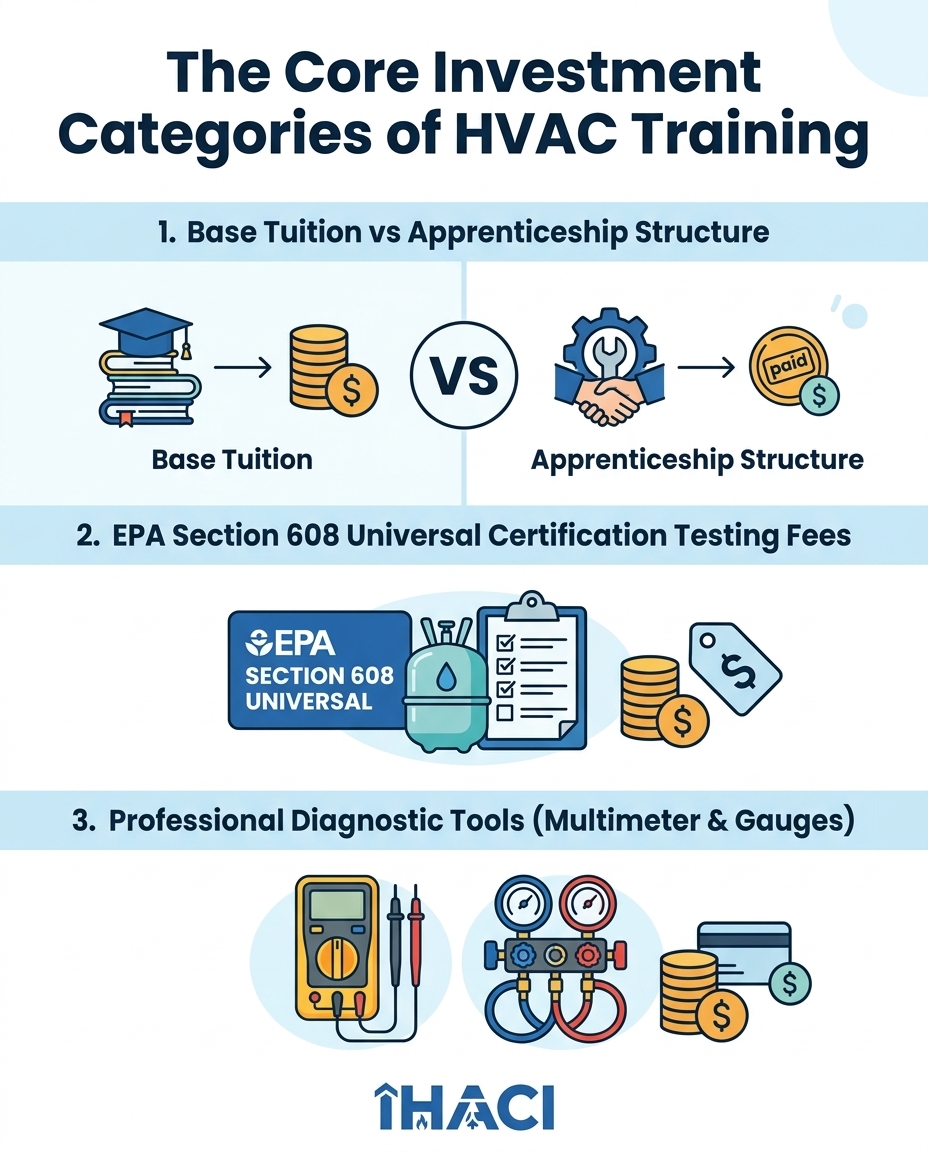
Advise breaking your budget into three distinct categories: tuition, mandatory tools, and certification testing fees. Start by securing the base tuition through savings, grants, or loans. Next, set aside a dedicated fund specifically for your True-RMS multimeter, manifold gauges, and basic hand tools. Finally, allocate a separate reserve for third-party exam fees and local licensing applications so you are never caught off guard when it is time to test.
Take the Next Step in Your HVAC Career Journey
Entering the HVACR industry is a highly rewarding decision, but it requires a clear-eyed understanding of the full financial commitment. By acknowledging that your base tuition is only one part of the equation, you can properly prepare for the essential diagnostic tools, federal testing fees, and local licensing requirements that define a professional technician. Whether you choose the structured path of a union apprenticeship or the flexible route of a non-union trade school, preparation is the key to day-one success in the field.
Understanding this comprehensive, realistic breakdown of non-tuition investments empowers you to make better career decisions and avoid unexpected financial hurdles. You do not have to navigate this complex landscape alone. Talk to an industry expert today and explore the professional resources and mentorship opportunities available to support your training journey from the classroom to the job site.
Subscribe to newsletter
Register for your FREE printed or digital subscription of ICN
Payments


