

Why the Online Application Pile Keeps Early-Career Technicians Stuck
If you want to look Beyond the Booths: How Navigating HVAC Trade Shows Accelerates Technician Careers, you first need to understand why submitting another carefully formatted resume to an online job board often leads to a frustrating cycle of complete silence. This digital stalemate drives many early-career technicians to finally attend an HVAC convention to break through the noise. The heating and cooling industry is experiencing rapid growth, backed by strong Bureau of Labor Statistics data showing high demand for skilled labor through 2032. Yet, despite this massive need for fresh talent, entry-level technicians often find themselves trapped in digital hiring queues. Automated tracking systems filter out resumes that lack specific keywords, and busy hiring managers rarely have time to sift through hundreds of identical applications. The critical decision point for any serious technician is realizing that passive job hunting rarely yields the best opportunities; active, in-person engagement is required to bypass the algorithms and get noticed by the people actually making the hiring decisions.
To truly advance your careers in HVAC, stepping onto the trade show floor is the most effective way to forge real connections that lead to an IHACI membership and long-term industry success.
The disconnect between the industry's desperate need for technicians and the individual struggle to get hired comes down to trust. Hiring managers are looking for candidates who demonstrate initiative, mechanical aptitude, and a genuine interest in the trade. These traits are nearly impossible to convey through a standard PDF resume. Based on our decades of hosting the IHACI trade show, our team sees exactly which technicians get hired and which remain stuck in the queue. The ones who succeed are those who understand that an industry event is not just a place to look at new tools—it is a live, interactive interview environment.
• Submitting identical resumes to dozens of digital portals. — The Trade Show Networking Approach: Having face-to-face conversations with local contractors and hiring managers.
• Hoping an automated system highlights your basic certifications. — The Trade Show Networking Approach: Demonstrating your hands-on knowledge by discussing specific equipment.
• Waiting weeks for a generic rejection email or complete silence. — The Trade Show Networking Approach: Walking away with direct contact information and an invitation to follow up.
• Competing against hundreds of unseen applicants based on paper credentials. — The Trade Show Networking Approach: Standing out as a proactive, engaged professional who takes their career seriously.
When you transition from a passive applicant to an active participant on the trade show floor, you change the entire dynamic of the job hunt. You are no longer just a name on a screen; you become a tangible professional who shows up, asks the right questions, and proves their dedication to the craft.
How to Network at an HVAC Convention: The Swag Collector vs. The Strategist
Walking into a massive convention center filled with hundreds of booths, heavy machinery, and thousands of attendees can be overwhelming. In our decades of hosting the IHACI trade show—especially during the busy fall season leading up to winter heating demands—we have observed two distinct types of early-career attendees walking the floor: the Swag Collector and the Strategist. The Swag Collector wanders aimlessly, grabbing free pens, koozies, and hats while avoiding meaningful eye contact with the people running the booths. They leave the event with a heavy bag of promotional items but zero professional connections. The Strategist, on the other hand, treats the convention floor like a targeted mission to bypass traditional hiring barriers.
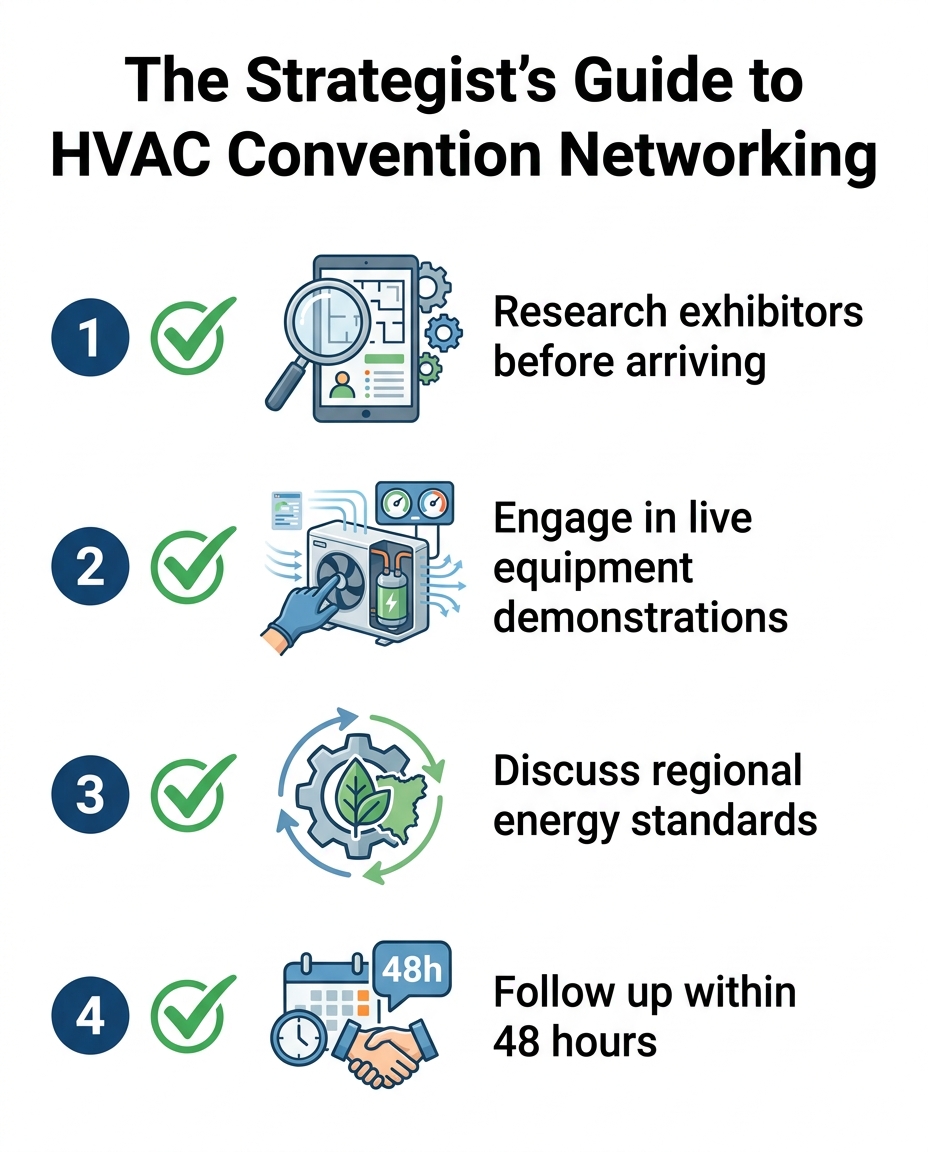
Here is how to network at an HVAC convention effectively and position yourself as a Strategist:
• Research exhibitors beforehand: Review the event map and create a targeted list of local contractors, prominent manufacturers, and training organizations you specifically want to speak with.
• Prepare a professional introduction: Craft a brief, 30-second summary of where you are in your career, highlighting your current training, recent certifications, and your eagerness to learn more about the field.
• Focus on quality over quantity: Instead of trying to visit every single booth, spend meaningful time at 10 to 15 targeted locations where you can have in-depth conversations.
• Ask targeted questions about equipment: Rather than immediately asking for a job, ask the representatives about the specific technology they are displaying to demonstrate your mechanical curiosity.
• Collect business cards strategically: When you receive a card, take a moment to write a quick note on the back about what you discussed so you can reference it later during your follow-up.
By adopting the mindset of a Strategist, you signal to industry veterans that you are serious about your future. Our team at IHACI consistently sees that contractors pay close attention to attendees who show up prepared, ask insightful questions, and treat the event as a professional development opportunity rather than a free giveaway spree.
Mastering Live Manufacturer Equipment Demonstrations
One of the most valuable resources at any industry event is the opportunity to interact with heavy machinery in real-time. Live manufacturer equipment demonstrations are the perfect low-pressure environment to interact directly with industry veterans, technical representatives, and lurking hiring managers. While the Swag Collector stands in the back of the crowd passively watching, the Strategist steps forward to engage. This is your chance to prove that your knowledge extends beyond textbooks and classroom theory.
Participating actively in these demonstrations bridges the gap between what you have learned and how it applies in the field. When you step up to a teardown of a new variable-speed compressor or a high-efficiency 96% AFUE furnace, you are putting your mechanical aptitude on display. It is a highly effective way to naturally weave in discussions about the essential diagnostic tools for HVAC troubleshooting that you are already familiar with, proving that you understand the practical side of the trade.
To master these live manufacturer equipment demonstrations, follow a deliberate approach:
1. Position yourself at the front: Don't hide in the back row. Stand where you can clearly see the components, access panels, and diagnostic ports being highlighted.
2. Observe the technical details: Pay close attention to how the representative navigates the unit's internal wiring, control boards, and specific installation quirks.
3. Engage the presenter: Wait for a natural pause in the demonstration to ask a specific, technically sound question that shows you understand the foundational mechanics of the system.
4. Network with fellow observers: The people standing next to you watching the demo are often local contractors or senior technicians. Strike up a conversation about their thoughts on the new model.
Questions That Impress Hiring Managers at the Booth
The questions you ask during a demo reveal your depth of understanding. Avoid basic inquiries that can be answered by reading the brochure. Instead, focus on practical, field-level concerns.
• Inquire about common troubleshooting scenarios: "What is the most frequent diagnostic code technicians encounter with this new control board during the first year of operation on a 3-ton unit?"
• Ask about efficiency improvements: "How does this model improve upon the previous generation's efficiency, specifically regarding the variable-speed blower motor?"
• Discuss real-world applications: "Are there any specific clearance requirements or installation quirks we should be aware of when retrofitting this unit into an older home?"
Connecting over these technical details proves your competence far better than a bullet point on a resume ever could. It shows you are already thinking like a working technician who anticipates the challenges of a real-world installation.
Leveraging Regional Compliance and Evolving Energy Standards
Technical knowledge of equipment is a great baseline, but understanding the regulatory environment sets you apart as an advanced, forward-thinking professional. Manufacturers and local contractors are highly focused on shifting energy regulations, compliance mandates, and the phasing out of older refrigerants like R-410A in favor of A2L refrigerants. Bringing up regional standards during a booth conversation signals that you understand the broader business context of the industry, not just how to turn a wrench.
For example, highlighting California's evolving energy standards and compliance regulations, such as Title 24 requirements, serves as a highly strategic conversation starter. From our perspective at IHACI, contractors operating in these heavily regulated environments face constant pressure to ensure every installation meets stringent efficiency codes to avoid fines and failed inspections. When you discuss how the new equipment featured in live manufacturer equipment demonstrations meets strict state-mandated 15.2 SEER2 and 7.5 HSPF2 ratings, you show that you are a strategic thinker. You demonstrate an understanding of the "why" behind the installation, which is exactly what contractors are looking for in their next apprentice.
Strategic conversation points regarding compliance:
• Refrigerant transitions: Ask how the manufacturer is supporting technicians through the shift to low-GWP (Global Warming Potential) refrigerants and what specific handling training is required.
• Efficiency mandates: Discuss how the newly showcased heat pumps perform in specific climate zones to meet the latest regional efficiency ratings.
• Documentation and testing: Inquire about the built-in diagnostic features that make it easier for technicians to prove system performance during a Title 24 compliance test.
Contractors are actively looking for apprentices who grasp these concepts because it reduces their liability and improves their bottom line. A technician who understands energy standards is less likely to make costly installation errors, making them an incredibly attractive hire.
Turning Booth Conversations into Apprenticeship Opportunities
Making a great impression at a booth is only half the battle; the next challenge is bridging the gap between a friendly technical conversation and securing a career-advancing role. The reality of the industry is that a vast majority of career placements occur through direct networking, word-of-mouth referrals, and personal recommendations—not through anonymous job boards. Contractors prefer to hire people they have met, spoken with, and vetted personally.
The Problem: Early-career technicians often freeze up after having a good conversation at a booth, unsure of how to transition the dialogue toward employment without sounding desperate or pushy. They leave the booth having made a friend, but not a professional contact.
The Cause: This hesitation stems from a lack of understanding about how apprenticeships are actually filled. Many technicians assume there is a formal, rigid application process they must follow, not realizing that contractors often create positions on the spot when they meet the right candidate.
The Solution: Use the momentum of your technical discussion to pivot naturally toward career pathways. When speaking with a contractor or manufacturer representative, ask directly about their preferred pathway for new technicians entering their specific sector. Inquire about what skills, mindsets, or certifications they feel are currently missing in today's applicant pool. For instance, you might ask, "What is the number one technical skill you find lacking in the apprentices you hire today?"
Once they share their insights, use that information to guide your ongoing HVAC education and training choices. If they mention a specific need for technicians skilled in low-voltage controls for 24V communicating systems or advanced airflow diagnostics, you now have a clear roadmap for your next educational step. More importantly, you can conclude the conversation by saying, "I am actively looking for an apprenticeship where I can develop exactly those skills. Who is the best person at your company to follow up with regarding entry-level opportunities?" Based on our decades of hosting the IHACI trade show, we consistently see that this direct, insight-driven approach yields the highest rate of successful job placements.
The Post-Convention Follow-Up Strategy
The most critical part of an HVAC convention does not happen on the bustling show floor; it happens in the quiet 48 hours after the doors close. You can have the most impressive conversations, ask the smartest questions, and collect a stack of business cards, but if you fail to follow up, you will quickly be forgotten. Hiring managers meet hundreds of people during a multi-day event. It is your responsibility to remind them who you are and why they should care.
A structured follow-up strategy ensures that the connections you made transition from brief encounters into lasting professional relationships. Here is how to execute a post-convention follow-up that gets results:
1. Organize your contacts immediately: While the event is still fresh in your mind, sort through the business cards you collected. Review the notes you wrote on the back of each card to recall specific conversation details.
2. Send personalized messages within 48 hours: Reach out via professional email or LinkedIn. Avoid generic messages like, "It was nice meeting you." Instead, reference a specific piece of equipment or topic you discussed.
3. Anchor the memory with a specific detail: Mention a distinct moment from the live manufacturer equipment demonstrations you watched together. For example: "I really enjoyed our conversation about the new variable-speed blower motor during the teardown demo on Tuesday afternoon."
4. State your intentions clearly: Reiterate your interest in an apprenticeship or entry-level role, and attach a clean, updated copy of your resume.
5. Express a desire to continue learning: Show that you are proactive by mentioning your plans to attend upcoming industry training seminars to further hone the skills you discussed at their booth.
A quick template for your follow-up email:
"Hi [Name], it was great speaking with you at the convention on [Day]. I really appreciated your insights on how California's new energy standards are changing your installation processes. As we discussed, I am actively seeking an apprenticeship to build my hands-on experience, particularly with the high-efficiency 18 SEER2 heat pump systems your team focuses on. I have attached my resume for your review and would love to know if you have a few minutes next week for a quick phone call. Thank you again for your time."
Frequently Asked Questions About Attending HVAC Trade Shows
Are HVAC conventions worth attending for technicians?
Yes, they are highly valuable for technicians at all career stages. Attending allows you to bypass automated online job portals and speak directly with hiring managers and local contractors. It also provides hands-on exposure to the newest equipment, tools, and regulatory updates—such as the 2025 refrigerant phase-downs—before they become standard in the field. For early-career professionals, it is the single best networking opportunity available.
What is the biggest HVAC trade show?
While there are several massive national and international events, regional shows often provide the best localized networking opportunities. The size of the show matters less than the concentration of local contractors and manufacturers who operate in your specific job market. Major organizational trade shows offer the perfect balance of large-scale manufacturer demonstrations and accessible local networking.
How do you network at a trade show if you have no experience?
If you lack field experience, lean heavily on your eagerness to learn and your foundational training. Focus on asking smart questions during equipment demonstrations rather than trying to prove what you already know. At IHACI, we regularly remind newcomers that contractors hire for attitude, mechanical aptitude, and reliability; demonstrating curiosity and professionalism on the trade show floor proves you have the right mindset for an apprenticeship.
How can I stand out for an HVAC apprenticeship at an event?
You stand out by acting like a professional rather than a passive attendee. Research the companies attending beforehand, prepare a concise introduction, and discuss industry-relevant topics like evolving energy standards or specific diagnostic techniques. Following up within 48 hours with a personalized message referencing your conversation is the final step that separates you from the rest of the crowd.
Do I need to bring a resume to an HVAC convention?
Yes, you should always have clean, crisp copies of your resume available in a professional folder. While you should not force a resume into everyone's hand, having it ready when a contractor asks for it shows preparation and organization. Ensure your resume highlights your certifications, completed training hours, and any relevant mechanical background.
Take the Next Step in Your HVAC Career Journey
Navigating trade shows strategically during the critical spring and fall shoulder seasons allows you to completely bypass the digital resume pile and forge the real, face-to-face connections that drive this industry forward. By engaging directly with live demonstrations, discussing regional compliance standards, and asking insightful questions of industry experts, you take active control of your career trajectory. You shift from hoping for an opportunity to actively creating one.
The connections you make on the convention floor are just the beginning. To continue building your professional network, staying ahead of evolving energy codes, and accessing premier training resources, exploring an IHACI membership is the logical next step. We encourage you to step away from the computer screen, step onto the show floor, and start building the relationships that will define your future in the trade.
Subscribe to newsletter
Register for your FREE printed or digital subscription of ICN
Payments


